Ella’s Lasting Injuries and Scars
Cinder & EllaElla’s lasting injuries and scars remain part of daily life long after the accident that killed her mother, shaping her mobility, pain, body image, and relationships. Her recovery restores much of her movement, but it does not erase her disability: she walks with a pronounced, painful limp and uses a cane, while the scars remain visible reminders of what she survived. The story gives these injuries both practical consequences and social weight, showing how barriers arise not only from Ella’s body but from inaccessible arrangements, stigma, and protective decisions made without her consent.
Physical consequences and recovery
At first, doctors did not believe Ella would regain the ability to walk without assistance. She nevertheless endured the pain of rehabilitation and recovered much of her mobility. Getting out of a car and pulling herself upright with her cane is still effortful and ungainly, but she takes pride in standing and walking independently. That achievement matters precisely because it is not a return to an undamaged past: the scars are already a substantial burden, and she does not want a wheelchair to become a lifelong necessity as well.
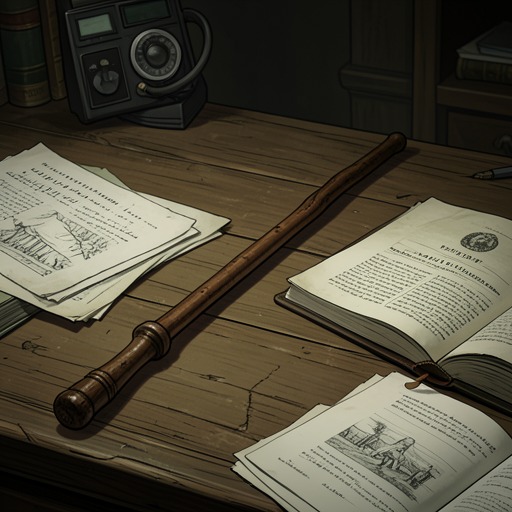
Her progress is significant without being complete. At FantasyCon, Ella explains to Brian Oliver that the staff she carries is not merely a costume accessory: her friend had made it to serve as a cane so that she could leave her regular one at home. Doctors had called it a miracle that she could walk at all after the accident, but walking remains slow and painful. She had taken so long to get from the fan gathering to the place where she was meeting Brian that she nearly arrived as late as he did. By identifying herself plainly as disabled, Ella makes the daily reality of her injuries explicit rather than allowing her costume or apparent mobility to conceal it.
Access and the social experience of disability
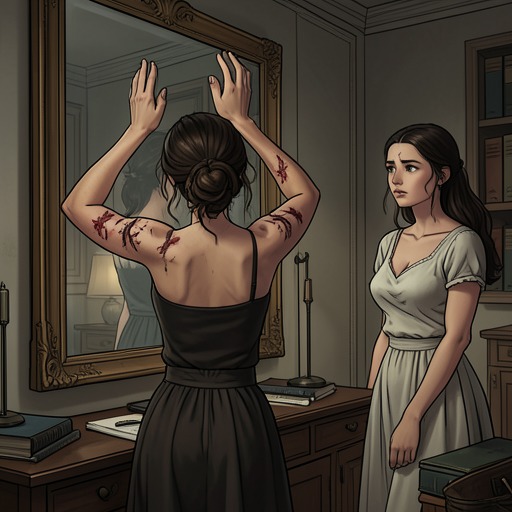
The story repeatedly distinguishes Ella’s physical limitations from the obstacles created by her surroundings and other people. At her new school, the uniform means short sleeves and a knee-length skirt, a sharp contrast with the clothes that had covered her from head to toe during the summer. Her anxiety is not simply about clothing: the uniform would expose parts of her body and scars to classmates she expects may be cruel. A standard school requirement thus becomes a source of vulnerability because it leaves little room for her to manage how much of her injured body is on display.
An even more direct access failure occurs when the twins’ car is arranged so that Ella is expected to climb into the back seat. She tells Anastasia that she cannot physically do so, but Anastasia responds that Ella should walk instead of expecting her to sit in the back for a year. The exchange turns an ordinary transport arrangement into exclusion: the problem is not that Ella has failed to try, but that the seat is inaccessible to her and her limitation is treated as an inconvenience. Juliette objects and tells Anastasia to get in, offering a contrast between dismissive conduct and recognition of Ella’s stated need.
Ella’s cane also makes her mobility visible in public, where visibility brings attention as well as practical support. At the film premiere, the cold makes her joints less cooperative and her limp more pronounced. She moves toward the theater one slow step at a time; people notice her gait, and their murmuring changes into cheers as they recognize her. The welcome does not remove the physical difficulty of crossing the distance. The crowd presses toward her, camera flashes disorient her, and she stumbles back against the ropes before a large, headset-wearing man catches her. Public celebration and bodily exposure arrive together: the crowd sees Ella, but the spectacle threatens to overwhelm her even as it celebrates her presence.
Scars, beauty, and public judgment
Ella’s scars influence how she anticipates being seen. When Jennifer suggests that Ella wear her mother’s dress to an event before hundreds of people and television cameras, Ella points out that the dress is revealing and that her scars would be visible. Her hesitation reflects more than modesty; it carries the history of people treating her badly since the accident and her consequent difficulty believing herself beautiful. Jennifer answers that she has never been ashamed of Ella and explains that she was concerned about Ella’s feelings, not about concealing her. As a model, Jennifer has also faced repeated criticism of her own appearance at castings. Her testimony does not make their experiences identical, but it complicates the assumption that beauty is a stable protection from scrutiny.
Brian’s public account of Ella’s refusal to become his girlfriend also identifies the pressure that her scars and disability exert on her self-image. He says she feared that people would not accept her and that she would harm his image and career. In his view, her scars signify strength: they show what she endured and survived. He calls her the strongest and most impressive woman he has met, while Ella’s friend Rob agrees. The praise offers a counter-reading to the stigma Ella has encountered, but it does not make the scars disappear or prove that public admiration alone can undo the hurt caused by rejection and harassment.
Independence, care, and narrative significance
Ella’s physical injuries are bound up with decisions about who gets to define her needs. During treatment, she asks for her father’s guardianship to be lifted when she is ready to leave the clinic. She acknowledges that he is trying to do his best, but argues that what suits him and his family may not suit her; what she needs is people who trust her. The request makes clear that care can become restrictive when other people’s judgment replaces her own, even when their intentions are protective.
In the same conversation about leaving treatment, Ella does not claim that her injuries, scars, her mother’s death, or her difficult relationship with her father have ceased to matter. She expects the challenges to feel harder outside the clinic, yet says she is ready to face them. Her plan to live with Vivian and Vivian’s fathers is, she explains, movement toward a support network she wants—not flight from her father or his family. The distinction places recovery alongside self-determination: Ella can need help and still choose where she lives and who provides it.
The injuries therefore do not function only as a before-and-after marker in a recovery plot. They recur in concrete questions of transport, clothing, walking distance, pain, and the visibility of scars, as well as in the social judgments Ella expects and sometimes encounters. Her regained mobility is real and hard won, but the account does not equate disability with failure or independence with needing no assistance. Instead, Ella’s insistence on naming her disability and asking for trust reframes strength as living with lasting consequences while retaining the right to make decisions about her own life.